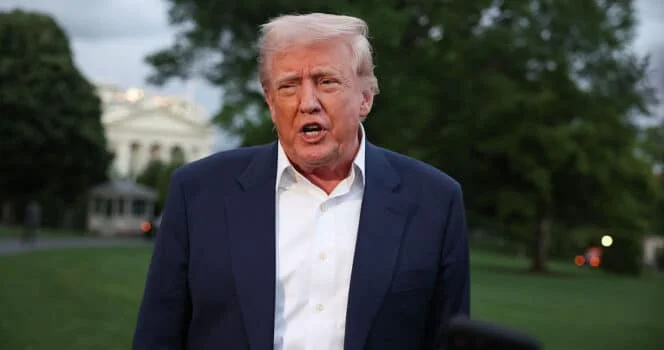
Donald Trump calls US ‘stupid country’ amid controversial case
When former President Donald Trump addresses the issue of immigration, he rarely holds back—and his latest remarks about birthright citizenship have reignited a fierce national debate.
Since returning to the Oval Office on January 20, Trump has wasted no time in advancing an aggressive policy agenda. From revamping trade agreements to launching new crackdowns on drug trafficking and violent crime, he has placed immigration reform front and center—a core element of both his previous presidency and his current term.
One of the most controversial components of his approach has been a renewed attempt to redefine the interpretation of the 14th Amendment, specifically the provision granting birthright citizenship to individuals born in the United States.
A Drastic Shift in Deportation Policies
Trump’s administration has implemented rapid, sweeping deportation efforts, using a blend of existing immigration laws and older wartime legislation to accelerate removals. Under these new policies, some non-citizens—particularly those suspected of violent crimes—have reportedly been sent to El Salvador’s massive, high-security “mega-jail” with limited or no formal legal proceedings. The deportation process is being fast-tracked through the use of emergency powers not invoked since World War II.
Additionally, a controversial new initiative is offering certain undocumented migrants a chance to take a “free flight” out of the U.S., accompanied by a small financial “exit bonus” designed to encourage voluntary departure. While supporters argue this reduces taxpayer burden, critics have likened the program to coerced expulsion under the guise of choice.
The 14th Amendment Under Fire
Trump’s most recent focus is on birthright citizenship, a right guaranteed by the 14th Amendment to the U.S. Constitution. The key clause reads:
“All persons born or naturalized in the United States, and subject to the jurisdiction thereof, are citizens of the United States…”
For more than 150 years, this language has ensured that anyone born on American soil—regardless of their parents’ legal status—automatically becomes a U.S. citizen. But Trump’s administration is once again challenging that long-standing interpretation, aiming to revoke citizenship rights from children born in the U.S. to undocumented immigrants, visa holders, or temporary residents.
While Trump previously attempted to issue an executive order to this effect during his first term, the effort was met with immediate and widespread legal opposition. Federal judges in Maryland, Massachusetts, and Washington blocked the order from taking effect, ruling that it conflicted with constitutional precedent and protections.
Trump Doubles Down on Truth Social
Now, in his second term, Trump is renewing the fight. Taking to his social media platform, Truth Social, he has made an emphatic appeal for the U.S. Supreme Court to revisit and overturn the 14th Amendment’s modern interpretation.
In a series of impassioned posts, Trump argued that the original intent of the amendment was solely to ensure citizenship for formerly enslaved people following the Civil War—not to allow children of undocumented immigrants to become automatic U.S. citizens.
“Birthright Citizenship was not meant for people taking vacations to become permanent Citizens of the United States of America,” he wrote.
“They’re bringing their families with them, laughing at the ‘SUCKERS’ that we are!”
Trump also falsely claimed that “The United States is the only Country in the World that does this,” despite the fact that over 30 other countries, including Canada and Mexico, have similar laws granting birthright citizenship.
“The drug cartels love it!” he added, suggesting that criminal networks exploit the policy to gain U.S. residency through newborns.
A Constitutional Debate Rooted in Civil War History
Continuing his posts, Trump laid out what he believes to be the true historical origin of the 14th Amendment. He emphasized that the amendment was proposed in 1866, shortly after the Civil War ended, and claimed it was never intended to apply to modern immigration scenarios:
“The Civil War ended in 1865. The Bill went to Congress less than a year later. It had nothing to do with Illegal Immigration for people wanting to SCAM our Country…”
He concluded with a direct appeal to the Supreme Court, insisting that it’s time to interpret the Constitution in a way that reflects today’s immigration realities:
“Please explain this to the Supreme Court… We didn’t have people pouring into our Country from all over South America and the rest of the World. It wasn’t even a subject. What we had were the BABIES OF SLAVES. Thank you for your attention to this matter. GOD BLESS THE U.S.A.!”
The Supreme Court Prepares to Weigh In
As the Supreme Court considers whether to take up the issue, Trump’s remarks are already fueling polarized responses. His supporters hail the move as a long-overdue correction to an outdated legal interpretation, while critics argue that revoking birthright citizenship would erode fundamental constitutional protections and unjustly target immigrant communities.
Legal experts point to the landmark 1898 Supreme Court case, United States v. Wong Kim Ark, which confirmed that children born in the U.S. to non-citizens are still citizens by birth. That decision has served as binding precedent for over a century and will likely be a key legal obstacle to any attempt to reinterpret the amendment.
What’s Next for America’s Citizenship Debate?
The issue of birthright citizenship is now front and center in the nation’s legal and political discourse. If the Supreme Court agrees to hear the case, it could reshape the very definition of American identity and inclusion, with consequences that stretch far beyond immigration.
As the legal battle unfolds, all eyes are on Washington—and on a debate that strikes at the heart of what it means to be born American.
What do you think about this renewed push to challenge birthright citizenship? Should the Constitution be reinterpreted to fit modern immigration challenges, or should the original protections remain untouched?
Join the conversation below.