Where Grandpa Went to Grieve
When Grandma died, everything felt still—yet unbearably heavy. At her funeral, people wept, hugged, and shared stories. But Grandpa? He stood quietly beside her casket, her favorite photo pressed tightly in his weathered hands. He didn’t speak. Not once. He just nodded politely at each person who offered condolences, his lips set in a firm line, as if the very act of forming words would shatter him. It was like watching a man hold up a house with his bare shoulders—one wrong move, and it would all collapse.
In the days that followed, we checked in constantly. We brought him homemade casseroles, offered to sit with him, to stay the night, to just be present. But Grandpa always smiled softly and waved us off with a gruff but tender, “I’m alright, kiddo.” His house was too quiet. Her absence filled every corner.
Then, without warning, he was gone.
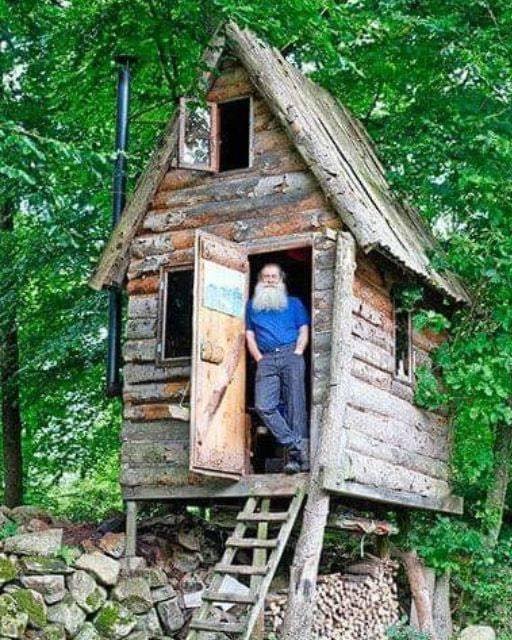
Panic gripped us. His phone rang unanswered, his car was missing, and none of us knew where he’d gone. Days passed. We filed a missing person report. Searched local areas. Then finally, a distant cousin remembered a place—an old cabin deep in the woods, the one Grandpa had built with his own hands when he was a much younger man, before the war, before children, before grief ever had a place at his table.
We drove for hours, winding through rural backroads, hearts heavy with fear and questions. When we reached the clearing where the cabin sat, surrounded by towering pines and the low murmur of wind, we saw smoke curling from the chimney. He was there.
Grandpa stood in the doorway, sawdust clinging to his flannel shirt, a small axe resting against the wall, and a calmness in his eyes that hadn’t been there in weeks. “I just needed stillness,” he said softly, his voice barely above the rustling leaves. “The world’s too loud when you’re trying to remember someone’s voice.”
The cabin was humble. One room, creaky floors, a pot of coffee on the wood stove, a small table with two chairs—one empty. The cot in the corner had an old wool blanket folded neatly at its foot. Everything smelled like pine, dust, and memories.
“It’s perfect,” I told him, stepping inside. I looked around at the simple beauty of it all, the honesty in the space.
Grandpa smiled faintly. “I didn’t come here looking for peace,” he said after a long pause. “I came because I couldn’t find it anywhere else.” He sank slowly into the chair by the window. “Fifty years with your grandmother… she was the melody to my silence. And now—now I don’t know what to listen for.”
He stared out into the trees. “I thought the quiet would fix me. But it doesn’t. Not really. It’s just… less painful than the noise.”
I sat beside him, not rushing his silence. After a while, I said gently, “Maybe peace isn’t something you find. Maybe it’s something you allow. Something you let in when you stop chasing the past or trying to fix the pain.”
He didn’t respond right away. But I knew he heard me. He was always a man of few words, but he listened with everything he had.
We stayed a few days. Chopping wood. Fixing the porch railing. Cleaning dust off old picture frames. In between chores, he told stories I had never heard—about Grandma as a young woman, how she made up silly songs while cleaning, how she once painted the kitchen cabinets without asking him, and how it became his favorite part of the house. He laughed through tears. Each memory was a stitch in his slowly healing heart.
One afternoon, while sweeping under an old shelf, I found a small envelope tucked behind a loose board. The paper was yellowed and delicate. On the front, in Grandma’s handwriting, was his name.
Inside was a letter—written long ago. A letter of love, reassurance, and gentle strength. She had written it “for a time when you feel far away.” It was full of little reminders: that she believed in him, that he was never alone, that grief might dull but love never would.
I read it aloud. The words trembled in the air, wrapping around the walls of the cabin like a warm quilt. Grandpa closed his eyes. When I looked over, he was holding the letter to his chest, breathing deeply. Then he whispered, “Maybe I can let go now.”
He stayed in the cabin a little longer—just a few more days to let the silence finish speaking to him. When he returned home, something had shifted. He wasn’t fixed. He wasn’t suddenly happy. But there was a softness in his shoulders. A steadiness in his step. He had let the grief settle beside him, rather than carry it alone.
Grief never fully disappears. It stays with us—quietly, persistently. But Grandpa had learned that peace isn’t a destination, not a cabin in the woods or a silence far from town. Peace is the slow process of learning to sit with pain instead of running from it. It’s realizing that love leaves echoes, and that healing comes not by erasing the sadness, but by folding it into our lives gently, like an old blanket we’ve learned to live with.
Loss doesn’t go away. But if we listen closely—beyond the noise, beneath the ache—it teaches us how to carry on. Not by forgetting, but by remembering with grace. Peace, it turns out, is not the absence of pain—it’s the quiet courage to feel it, and keep going.