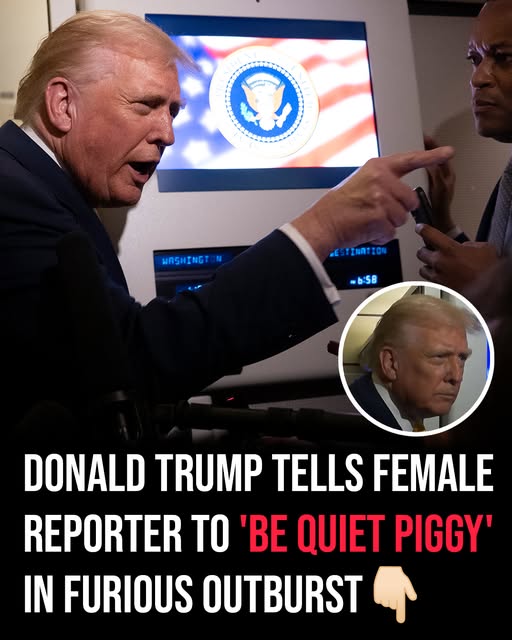
Trump erupts at female reporter with the words, “Be quiet, piggy.”
In a week already marked by political friction, legal controversy, and renewed debates surrounding the unreleased Jeffrey Epstein files, former President Donald Trump provoked a fresh wave of national outrage following an explosive confrontation aboard Air Force One. What began as a routine media briefing quickly spiraled into a moment critics have labeled one of the harshest and most demeaning personal attacks he has ever directed at a journalist.
The incident, captured on video and shared across global media platforms, showed Trump turning sharply toward Bloomberg reporter Catherine Lucey and snapping: “Quiet! Quiet, piggy.” The remark, delivered with a pointed finger and audible irritation, instantly ignited backlash — not only for the insult itself, but for the broader implications it carries amid Trump’s long history of tense, combative exchanges with the press.
The reversal stunned journalists, who pressed for clarification. It was during this follow-up questioning — specifically when Lucey attempted to ask why, if he had nothing to hide, he would not immediately support the release of all documents — that Trump snapped. The room fell silent. Several reporters glanced at one another, unsure whether to continue, challenge the remark, or move on. Ultimately, the moment passed in real time — but it soared across the internet within minutes.
“Irony has packed its bags and left the building.” Political analysts quickly weighed in as well, noting that Trump’s personal, appearance-based insults have historically targeted women more often than men — particularly female reporters who challenge him publicly.
Why This Moment Feels Different
Yes, Trump has a long history of sparring with the media. Yes, he has mocked, insulted, berated, and dismissed journalists for years. But several factors distinguish this incident from past clashes:
1. Timing and Tension
This confrontation came just days after Trump reversed his stance on releasing Epstein-related documents — a topic already fraught with legal, political, and reputational risk. Reporters were asking pointed questions. Trump was visibly irritated.
2. The Target
Catherine Lucey is widely respected in Washington for professionalism, neutrality, and thoroughness. She is not known for confrontational questioning.
3. The Language
Calling a woman “piggy” is loaded with gendered implications — body-shaming, infantilizing, and demeaning all at once.
Critics say this crosses into explicitly misogynistic territory, intensifying the outrage.
4. The Silence of the Room
One of the most discussed aspects of the incident wasn’t Trump’s insult — but the press corps’ reaction. They stayed quiet. Some said the silence was professional restraint. Others called it fear. Many called it shameful. A viral comment read: “The entire White House Press Corps sat in silence while a female colleague was humiliated. This is what normalized abuse looks like.”
The Administration’s Response: Deflect, Redirect, Blame the Reporter
Instead of apologizing or clarifying, the administration doubled down. According to MSNBC correspondent Vaughn Hillyard, a senior official said:
“The reporter behaved in an inappropriate and unprofessional way. If you give it, you have to be able to take it.”
What exactly she did “inappropriate”?
They didn’t say.
This silence, critics argue, fits a familiar pattern:
-
When confronted,
-
deny wrongdoing,
-
attack the journalist,
-
and frame criticism as overreaction.