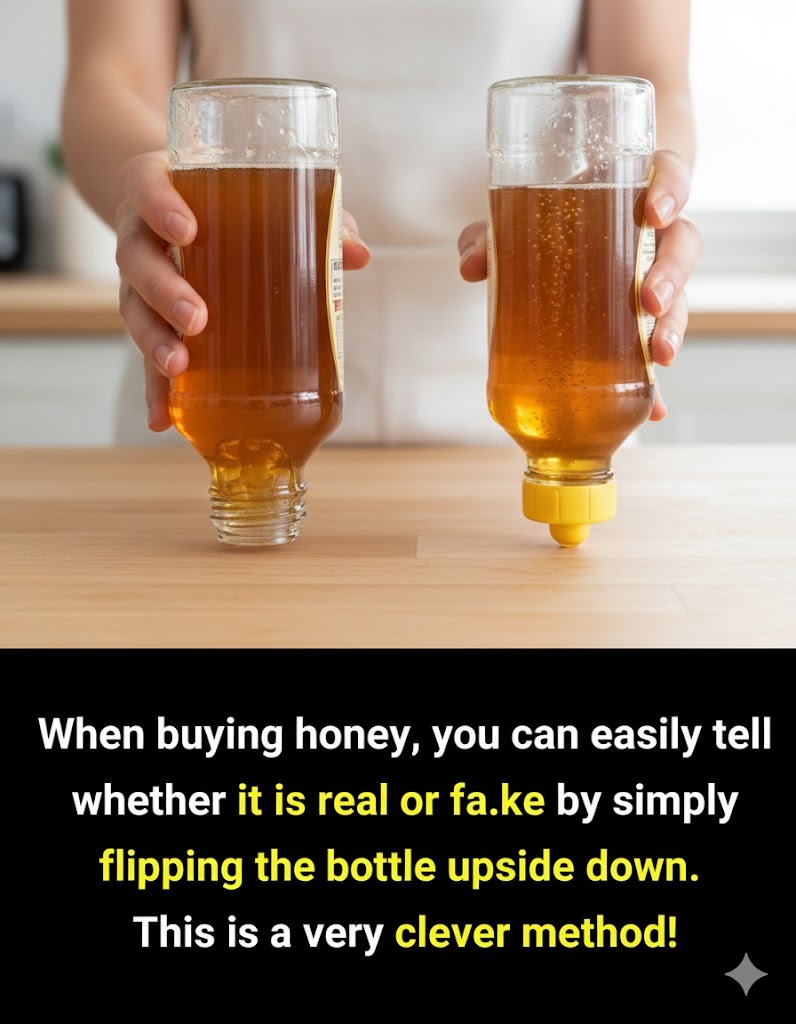
A simple trick to tell real honey from fake: Just flip the bottle upside down
You have probably seen the viral tip telling people to flip a bottle of honey upside down and judge its quality by how fast it moves. The claim is simple. If the honey forms a slow moving bubble or barely shifts at all, it must be real. If it pours quickly like water, it must be fake. This idea feels clever, quick, and scientific, which is exactly why it spreads so easily. Unfortunately, it is also unreliable and often misleading.
What the Bottle Flip Test Claims
The logic behind the trick is based on thickness. Real honey is naturally viscous, meaning it flows slowly. When the bottle is inverted, the honey should resist movement, sometimes creating a single slow bubble rising through the bottle. Fake honey, which is said to be diluted with corn syrup, sugar water, or glucose, should appear much thinner and rush toward the opening. While this sounds convincing, real honey does not behave the same way under all conditions.
Why the Trick Fails
Temperature changes everything.
Honey is highly sensitive to temperature. In warm conditions, real honey becomes significantly thinner. On a hot summer day or in a warm kitchen, even raw, high quality honey can flow easily and resemble what people think of as fake honey. In cold conditions, the same honey thickens and barely moves. Judging purity without controlling temperature makes the test meaningless.
Processing affects texture.
Many people assume that if honey is thin it must be fake, but that ignores how commercial honey is processed. Even honey that is completely pure is often heated and finely filtered before bottling. This removes pollen and tiny wax particles that normally help raw honey stay thick. Heating also changes viscosity. As a result, supermarket honey can pour much faster than raw honey while still being genuine.
Some fake honey is thick on purpose.
Producers who adulterate honey are well aware of the thickness myth. Many blends of high fructose corn syrup or glucose are intentionally thickened so they look and behave like real honey. Some are even thicker than authentic honey. This means a slow moving bottle can still contain adulterated product.
Bottle shape changes flow.
The design of the container itself influences what you see. Narrow necks restrict movement and slow everything down. Wide openings allow faster flow. Two identical honeys in different bottles can appear completely different when flipped.
More Reliable Ways to Test Honey at Home
While no home test is perfect, some methods give better clues than simply watching bubbles.
Water test.
Drop a spoonful of honey into a glass of water. Real honey tends to settle in a lump at the bottom before slowly dissolving. Many adulterated honeys dissolve quickly. This is not foolproof, but it offers more insight than the flip test.
Thumb test.
Place a small drop on your thumb. Real honey stays in place and does not spread much. Adulterated honey often runs or spreads faster. Again, temperature and processing still affect results, but this test can reveal obvious dilution.
Crystallization over time.
Pure honey naturally crystallizes. Some types crystallize within weeks, others over months. Honey that never crystallizes may still be real, especially if it was heated, but crystallization strongly suggests authenticity.
Flame test with caution.
If you dip the tip of a dry match into honey and try to light it, pure honey will usually allow it to burn because it contains little moisture. Adulterated honey may not. Use care and do this safely.
The Real Gold Standard
The only way to be certain is laboratory testing that measures pollen content and sugar composition. For everyday consumers, the most reliable protection is buying from trusted local beekeepers or reputable brands that provide sourcing transparency.
In short, the bottle flip test feels simple and satisfying, but nature and chemistry are far more complicated than a viral trick suggests.