Almost no one recognizes this antique tool – are you one of the few who do?
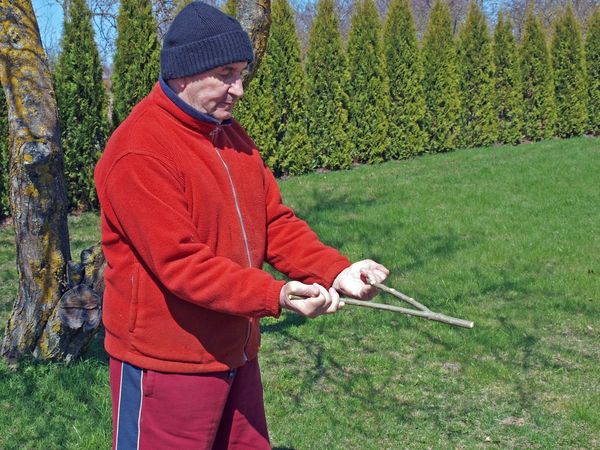
Long before satellite maps, digital surveys, and towering drilling rigs became the standard tools for finding water, many rural families relied on something far simpler and far more mysterious. A slender V shaped branch, cut fresh from a tree, was believed to hold the power to reveal what the human eye could not see. Hidden streams and underground springs were thought to announce themselves through the subtle movement of that forked stick. Held lightly in both hands, the branch was said to twist or dip when its bearer walked across a buried source. For those who trusted the practice, this was not just a method. It was a quiet ritual shaped by hope, faith, and necessity. Wells were dug, crops were planted, and sometimes entire settlements took shape based on the silent language of that trembling branch.
In many communities, the dowser was a respected figure. Often it was an elder who had learned the craft from a parent or grandparent. Stories tell of men and women pacing slowly across dusty fields, eyes focused not on the horizon but on their hands, attuned to the smallest shift of pressure or pull. Neighbors would gather at a distance, watching in hushed anticipation. When the branch finally dipped, a stake was driven into the soil and the waiting began. Days or weeks later, the first splash of water against stone would draw cheers, relief, and sometimes tears. In places where rainfall was rare and survival depended on a single reliable well, hope itself felt as fragile as the dry ground beneath their feet.
Science has since dismissed water dowsing as superstition, attributing its apparent success to chance, subconscious movement, and confirmation bias. Careful studies have found no consistent evidence that a stick can detect water hidden deep underground. Yet the stories endure. They live on in family memories of grandfathers who swore by the practice, of fields that seemed barren until the branch spoke, of wells that filled clear and cold against all expectations. Whether the power came from the earth or from the human mind searching for meaning, the results often felt miraculous to those who needed them most.
What gives the practice its lasting hold is not only the question of whether it works, but what it represents. Water dowsing was born from a time when people lived much closer to uncertainty. Without charts or machinery, choices were guided by instinct, tradition, and trust. The branch became a symbol of humanity reaching out into the unknown, asking the world to answer in some small visible way. It reflected the deep hunger for reassurance when survival balanced on unseen resources buried beneath the soil.
Even today, in an age of data and technology, the image still carries power. Some modern farmers quietly admit they tried dowsing before calling in the professionals. Others keep the story alive as a piece of local heritage, passed down like an heirloom. It reminds us that progress does not erase the emotional roots of human behavior. We still seek signs. We still look for patterns. We still hope for guidance when certainty feels out of reach.
That ordinary branch, simple and easily overlooked, ultimately carries a much larger story. It speaks of endurance in harsh landscapes, of imagination standing in for knowledge, of belief stepping in when answers were scarce. Whether one sees dowsing as magic, coincidence, or comfort, it remains a powerful reminder of our timeless need to trust in something just beyond explanation.