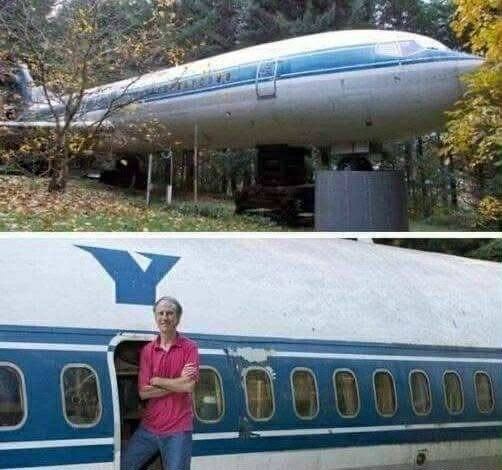
Wait Until You See Inside This Man’s Home, Which He Made Out of an Airplane
Bruce Campbell has always had a rare ability to see possibility where others see limitations. In his early twenties, long before his unusual home became famous, he made a bold and quiet decision that would shape the rest of his life. He purchased 10 acres of wooded land in rural Oregon for just 23000 dollars, not with plans for a conventional house, but with the goal of creating something entirely different. Even then, Campbell was not interested in following traditional ideas of what a home should be.
At first, he imagined building a house out of cargo containers. The concept appealed to his passion for engineering, reuse, and efficiency. But his vision took a dramatic turn after he learned about a woman who had converted a retired Boeing 727 into a residence. The idea fascinated him. If an airplane could be reborn as a living space, then his dream of unconventional housing could reach an entirely new level. Inspired by her example, Campbell decided to pursue a similar path but with his own distinct approach.
In 1999, after years of research and planning, he purchased a retired Boeing 727 from Olympic Airways for 100000 dollars. The aircraft had previously flown passengers across the skies of Europe, and now it was destined for a second life deep in the forests of Oregon. Getting the massive plane from Athens, Greece, to his property was one of the most complex parts of the project. The transport alone cost an additional 120000 dollars, bringing the total investment to 220000 dollars. It was a huge financial and logistical challenge, but for Campbell, the value of the dream far outweighed the expense.
Once the aircraft arrived on his land, the real transformation began. Rather than stripping the plane down completely, Campbell chose to honor its original design. He preserved much of the structure, including the cockpit, which remains one of the most striking features of the home. The rows of windows that once framed the sky now flood the interior with natural light. Inside, he created a modest but functional living space that includes a small kitchen, a shower, and a sleeping area. The result is not luxurious by modern standards, but it is deeply personal, practical, and full of character.
More than a novelty, Campbell’s airplane home reflects a serious commitment to sustainability. By repurposing a retired aircraft, he prevented thousands of pounds of high quality materials from becoming waste. Airplanes are designed to endure extreme conditions, from freezing temperatures to intense air pressure, which makes them remarkably durable for long term use. The aluminum shell is resistant to weather, fire, and decay, giving the home a lifespan that could easily exceed that of many traditional houses.
The path to completing this project was far from smooth. Transporting the plane through international routes, securing permits, placing it safely on the property, and converting it into a livable structure presented countless technical and legal challenges. Each obstacle demanded creativity, patience, and problem solving. Many people would have given up along the way, but Campbell saw every difficulty as part of the process rather than a reason to stop.
Today, his Boeing 727 home stands quietly among the trees as a powerful symbol of imagination and resourcefulness. It is not simply a place to live. It represents the idea that homes do not have to follow a single pattern. They can be shaped by passion, innovation, and respect for the environment. Campbell’s story continues to inspire people around the world to question conventional limits, to see potential in overlooked spaces, and to believe that even the most unlikely dream can take flight with enough perseverance and vision.