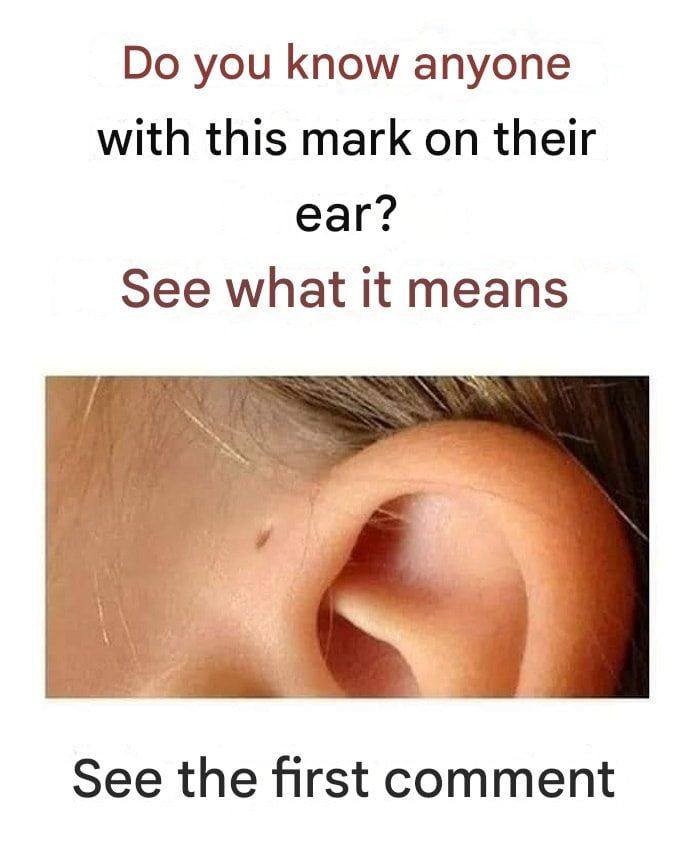
Here is what this little hole on the ear mean
When we think of rare physical traits, we often imagine dramatic features that immediately draw attention. Yet some of the most unusual traits are so subtle that they often go unnoticed, even by the people who have them. One such example is a tiny hole or dimple located near the top of the ear. This feature is known as a preauricular sinus. At first glance, it can look like a small scar, a faint birthmark, or even an old piercing. In reality, it is none of those.
A preauricular sinus, sometimes referred to as a preauricular pit or fistula, is a small congenital opening that forms during early fetal development. It develops around the sixth week of gestation, at a time when the structures of the ear are forming. When certain tissues do not fuse completely, a narrow tract or pit can remain. This process happens before birth and is not caused by injury or environmental factors later in life.
In many cases, this trait is hereditary. It can run in families and be passed down through generations, sometimes appearing in parents, children, or siblings. The sinus may appear on one ear or both, though having it on both sides is considered uncommon. Because it is usually painless and small, many people live their entire lives without realizing they have it.
For most individuals, a preauricular sinus causes no problems at all. It is considered a benign condition and does not affect hearing or overall health. However, because the pit can connect to a small tract beneath the skin, it can sometimes trap bacteria. When this happens, the area may become infected, leading to redness, swelling, tenderness, or discharge.
When infections occur, they are typically treated with antibiotics. Doctors may also recommend warm compresses and careful hygiene to reduce irritation. In cases where infections happen repeatedly, a minor surgical procedure may be suggested to remove the sinus completely. This surgery is usually straightforward and prevents future complications.
Medical professionals generally advise people with a preauricular sinus to keep the area clean and to watch for any changes. Early attention to redness or discomfort can prevent more serious infections. Outside of these occasional concerns, the condition does not interfere with daily life.
Beyond its medical aspects, the preauricular sinus is fascinating from a developmental and evolutionary perspective. It highlights how small variations in early development can leave lasting physical markers. Some researchers have even speculated about deeper evolutionary roots. Evolutionary biologist Neil Shubin has suggested that these tiny openings could be remnants linked to ancient aquatic ancestors, possibly connected to structures similar to fish gills. While this idea is intriguing, it remains a theory without definitive evidence.
Most experts agree that regardless of its origins, the preauricular sinus is simply a harmless quirk of human development. It poses little to no health risk for the majority of people who have it.
Ultimately, these small ear dimples serve as quiet reminders of how complex and varied human biology truly is. They show that even the smallest details can carry stories about development, genetics, and our shared past, making every body uniquely its own.