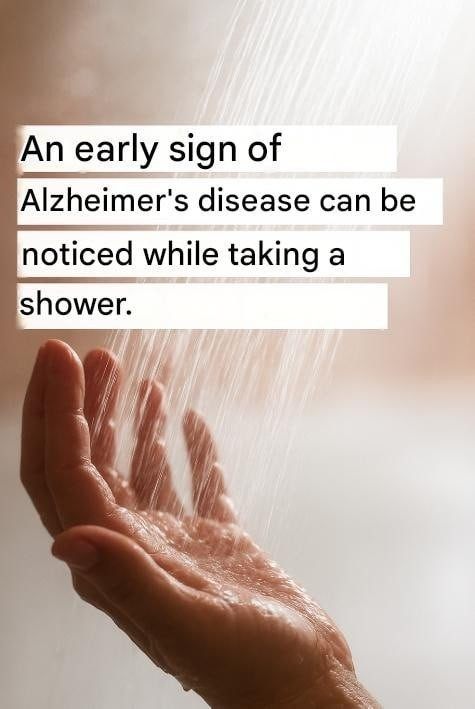
An Early Sign of Alzheimer’s Disease Can Be Noticed While Taking a Shower: What Should You Look Out For?
No Longer Recognizing the Smell of Soap: A Signal Not to Ignore
Imagine this: you open your usual shower gel — the one you’ve used for years — and suddenly… nothing. Or perhaps only a faint scent that is difficult to recognize.
This seemingly trivial change could sometimes be an early sign of cognitive decline, according to Professor Davangere Devanand, a psychiatrist and neurologist at Columbia University in New York.
Why? Because the sense of smell is closely connected to memory. Early-stage Alzheimer’s disease can affect the brain regions responsible for identifying and processing scents.
🧠 When the Nose Knows Before the Mind
It may sound surprising, but our sense of smell can reveal what’s happening deep within the brain long before the more obvious symptoms of Alzheimer’s disease appear.
According to recent research, difficulty recognizing familiar scents — such as soap, coffee, or perfume — may be one of the earliest indicators of cognitive decline.
👃 The Science Behind Smell and Memory
Our sense of smell is directly connected to the olfactory bulb, which is closely linked to the hippocampus and amygdala — areas of the brain responsible for memory and emotions.
These regions are often among the first affected by Alzheimer’s disease.
This explains why some patients may lose the ability to distinguish scents before noticeable memory problems appear. The brain simply stops processing smells the way it once did, which can lead to confusion or the inability to recognize certain odors.
Professor Devanand notes that smell tests may soon become an important tool for early detection, because they can reveal subtle neurological changes years before typical symptoms develop.
🧴 Everyday Signs You Shouldn’t Ignore
It’s not just about the smell of soap in the shower. You should pay attention if you notice that:
-
Your coffee doesn’t smell as strong as it used to.
-
Flowers or perfumes seem faint or unfamiliar.
-
You begin confusing different scents.
-
Foods you once enjoyed seem less appealing because their aroma feels weaker or “empty.”
While many factors can temporarily affect the sense of smell — such as colds, allergies, infections, or normal aging — a persistent loss of smell without a clear cause may be worth discussing with a doctor.
🩺 What Research Shows
A major study conducted at Columbia University found that older adults who had difficulty identifying common odors (such as soap, lemon, or cinnamon) were more likely to develop Alzheimer’s disease within the next five years.
Researchers believe that smell tests could become a simple, non-invasive, and low-cost screening method for detecting early Alzheimer’s risk.
Unlike brain scans or long cognitive tests, these smell tests can be performed quickly and may detect subtle changes years before memory loss becomes obvious.
💡 What You Can Do If You Notice a Change
A sudden difficulty recognizing familiar smells doesn’t automatically mean Alzheimer’s disease. However, it’s important to take it seriously.
Here are a few steps you can take:
Rule out simple causes
Conditions such as sinus infections, nasal polyps, allergies, or even COVID-19 can temporarily affect the sense of smell.
Monitor how long it lasts
If the issue persists for several weeks or months without explanation, consider speaking with a healthcare professional.
Request a medical evaluation
A neurologist can perform smell identification tests and cognitive assessments.
Adopt brain-healthy habits
Regular exercise, good sleep, mental stimulation, and a Mediterranean-style diet rich in antioxidants may help reduce the risk of cognitive decline.
Stimulate your sense of smell
Regularly smelling herbs, spices, or essential oils may help keep the olfactory system active.
🧠 Prevention Starts with Awareness
The next time you take a shower, don’t just focus on getting clean — take a moment to notice what you smell.
Something as simple as recognizing whether your favorite soap smells the same can be a small but meaningful way to stay aware of changes in your brain health.
Alzheimer’s disease doesn’t appear overnight. It often begins with subtle, easily overlooked changes — and sometimes, your nose may notice them long before your memory does.