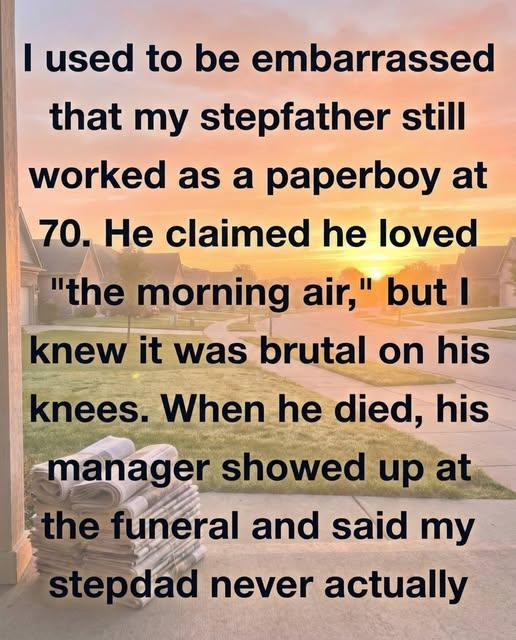
I Thought My Stepfather Was a Paperboy
His answer never changed.
“The route’s my responsibility.”
To me, it was just a paper route. A small, stubborn routine that seemed to define the limits of his retirement.
Then, six months ago, the inevitable happened.
He was halfway through the Sunday delivery—the thickest edition—when he had a heart attack. Fast. Sudden. He collapsed at the curb on Maple Street, one hand resting on the bundled papers, the other pressed to his chest.
The funeral was small. Quiet. Just like Patrick.
Neighbors came. A few of my mother’s old friends. Me. We stood around, unsure what to do with our hands or our grief, when a man in a crisp suit—slightly too new—walked in. He didn’t quite fit. He wasn’t openly mourning. He seemed more… official.
After the service, he came straight to me.
“Mr. Hayes?” he asked, offering a manicured hand. “Martin O’Connell. I was Patrick’s manager at the Town Herald.”
I thanked him, surprised he’d come at all. “He was very dedicated.”
Martin hesitated, then leaned closer and lowered his voice.
“Alistair… Patrick never actually worked for the Town Herald.”
My stomach clenched. “What are you saying? I saw him leave every morning. He got a weekly check.”
“Yes. An expense allowance. I wrote it myself,” Martin said. “The paperboy routine—the bike, the early mornings—was a cover. For twenty years.”
He pressed a heavy business card into my palm. No company name. No logo. Just a phone number and two initials: C.B.
“He asked me to give you this after the funeral,” Martin continued. “In case you ever needed answers.”
“Answers to what?” I asked.
“To who Patrick really was.”
I drove home in a haze, the card burning in my pocket. The house felt hollow without him. My mother had died years earlier. Now it was just me—and questions I’d never thought to ask.
The next morning, I called the number.
“C.B.,” a calm voice answered.
“My name is Alistair Hayes,” I said. “My stepfather… Patrick Hayes.”
There was a pause. Then the voice softened.
“Please come in. He was… a legend here.”
The office was tucked inside an ordinary downtown building, easy to overlook. Inside, the security was anything but ordinary. I was escorted to a conference room, where a woman named Catherine was waiting.
She didn’t waste time.
Patrick, she explained, had spent decades working in high-level government intelligence—financial forensics, digital ghosting, tracing illicit money across continents. He could unravel shell companies and invisible transactions from fragments most people wouldn’t even recognize as clues.
They called him the Ghost Finder.
The paper route wasn’t just a disguise, she said. It was operational brilliance. It put him on the streets at unusual hours. It gave him access—to conversations, routines, patterns. Some customers were contacts. Some were assets. And sometimes the newspapers carried more than headlines: microdots, encrypted drives, coded messages hidden in plain sight.
“He helped dismantle an international crime ring two years ago,” Catherine said. “All because he noticed a single recurring payment that didn’t add up.”