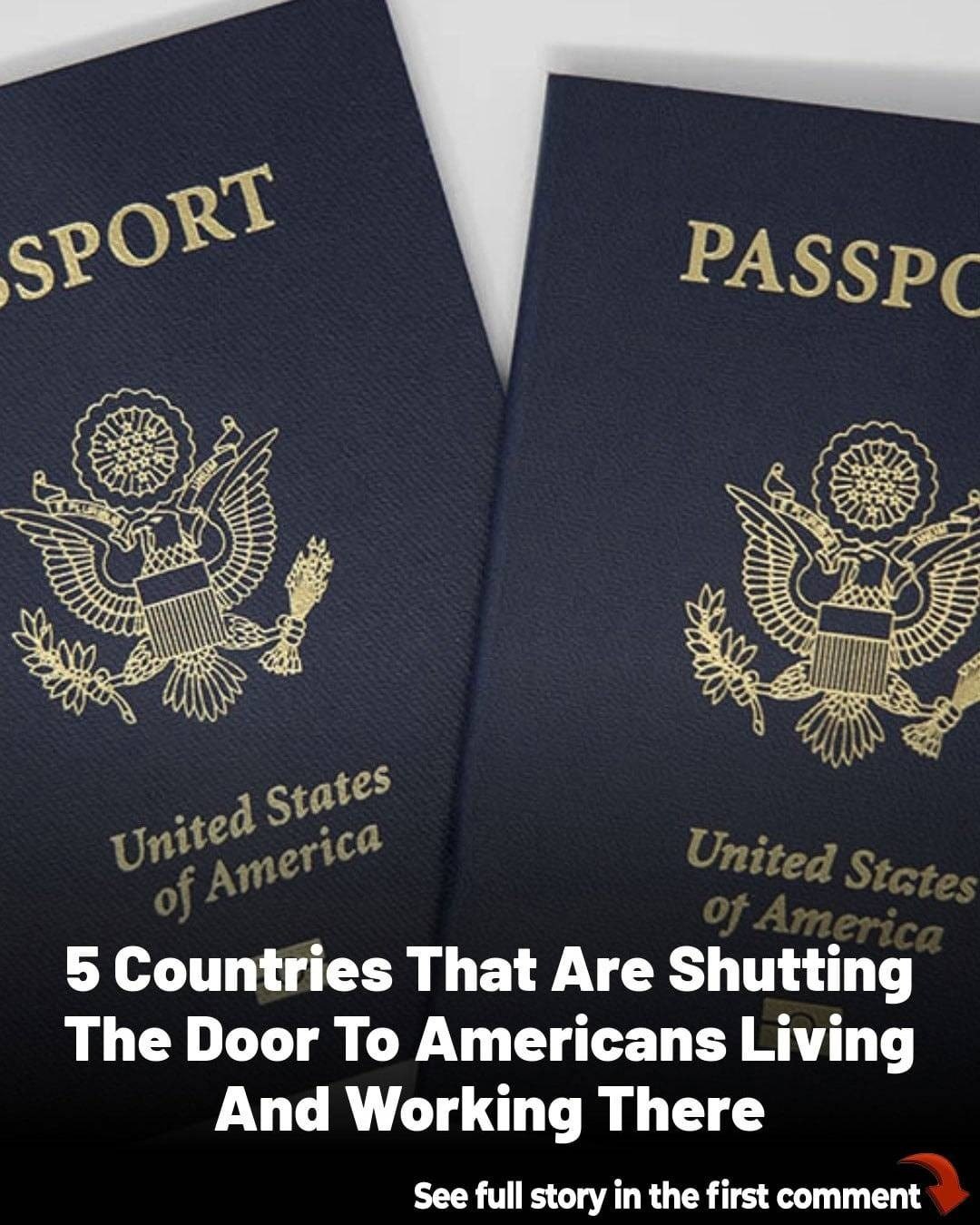
(The Expat Barrier) 5 Countries Making It Much Harder for Americans to Live and Work Abroad Right Now
For generations, the American passport was viewed as the ultimate “golden ticket”—a prestigious, powerful document that could unlock doors to almost any corner of the globe with little more than a smile and a stamp. From the sun-drenched, olive-grove coasts of the Mediterranean to the neon-lit, high-octane tech hubs of Southeast Asia, U.S. citizens have historically been greeted as the preferred guests of the world. Whether it was a young professional fleeing the corporate grind for a better work-life balance or a retiree looking to stretch a modest pension into a life of luxury, the world felt like an open book with endless chapters. However, as we navigate the complex reality of 2026, that book is becoming significantly heavier, and for many, it is beginning to slam shut.
The global landscape for expatriates is undergoing a profound and jarring transformation that goes far beyond mere paperwork or airport logistics. We are witnessing a fundamental shift in how sovereign nations perceive foreign residency. Many countries that once aggressively courted Americans with specialized “Digital Nomad” visas and streamlined residency paths are now slamming the brakes. This cooling of relations isn’t the result of a single policy but is a complex cocktail of local housing crises, heightened national security anxieties, and shifting geopolitical alliances. What was once a straightforward move across an ocean has evolved into a grueling gauntlet of red tape, legal risks, and extreme uncertainty. If you are planning to pack your bags this year, you must realize that the “welcome” sign is rapidly being replaced by a “restricted entry” notice.
The Digital Nomad Paradox: The Cost of Popularity
The irony of the current situation is that while the barriers are rising, the American desire to live abroad has reached a fever pitch. The post-pandemic era solidified a “work from anywhere” culture that is no longer a luxury but a requirement for a new generation of professionals. Social media feeds are an endless loop of romanticized imagery—influencers showcasing the idyllic life of a remote worker in a Lisbon cafe or a family settling into a lush villa in Bali. This curated version of the “Expat Life” has triggered a massive surge in Americans moving overseas, but this influx has created a classic “too much of a good thing” scenario for local governments.
In popular destinations like Portugal, Mexico, and Thailand, the sheer volume of newcomers has begun to fray the social and economic fabric of local communities. In major cities, the phenomenon of “gentrification” has gone global, and the results are often devastating for the locals. When a remote worker earning a high-tier U.S. salary moves into a neighborhood where the local average wage is only a fraction of that, the market responds instantly. Rents skyrocket, local shops turn into expensive boutiques, and the very people who give a city its soul find themselves priced out of their own homes. Consequently, governments are being forced to make a hard choice: continue reaping the short-term economic benefits of foreign spending or protect the long-term stability of their own citizens. This tension is the primary engine behind the new walls being built around residency permits and long-term stays.
The Hunger for a Slower Life in a Complicated World
Despite these mounting hurdles, the urge to leave the United States remains a matter of survival—both financial and mental—for many families. The cost of living in American metropolitan centers like Seattle, New York, or San Francisco has become a crushing weight that prevents many from ever achieving the “American Dream” at home. When comparing the price of a cramped apartment in a high-stress U.S. city to a spacious, historic home in a safe, walkable European or Latin American community, the choice seems logically undeniable.
Beyond the financial spreadsheet, there is a deep cultural hunger for “slow living”—a desperate desire to escape the “hustle culture” of the States where worth is measured by productivity. Americans are seeking communities where family, food, and leisure are not just weekend activities, but the center of existence. Retirees are hunting for high-quality, dignified healthcare that won’t bankrupt their estates, while younger generations want an international education for their children that offers a broader, more empathetic worldview. They want the thrill of a new language and the texture of a different culture. However, as these human aspirations collide with the rigid reality of 2026 immigration policies, many Americans are discovering that their “escape plan” now requires a level of strategic planning and legal maneuvering that they never anticipated. The golden ticket still exists, but the price of admission is no longer just a passport; it’s a commitment to navigating a world that has grown weary of the “uninvited” guest.
1. Japan: The Digital Border and the End of Spontaneous Entry
Japan has long been a dream destination for Americans—a perfect blend of futuristic technology and ancient tradition. For years, U.S. citizens could fly into Tokyo or Osaka with nothing more than a passport and a smile, staying for up to 90 days. But that era of “spontaneous travel” is coming to a close. By 2026, the Japanese government is moving aggressively toward a more controlled border, with the full rollout of JESTA (Japan Electronic System for Travel Authorization) targeted for later this decade and interim stricter screenings already in place.
The Rise of JESTA and Pre-Travel Screening
Much like the American ESTA or the European ETIAS, JESTA requires travelers from visa-exempt countries to submit their personal details, travel history, and specific itineraries online well before they ever board a plane. This isn’t just a formality; it is a sophisticated pre-screening tool designed to flag individuals who might pose a security risk or, more commonly, those intended to work illegally or overstay their welcome. In the 2026 landscape, the Japanese government is prioritizing “quality over quantity,” shifting its focus toward high-value tourism while tightening the net around those who treat the country as a long-term playground without the proper legal status.
The Triple Threat: Fees, Taxes, and Enforcement
Furthermore, Japan is significantly increasing the financial cost of entry and exit to combat the systemic strain of “over-tourism.” From July 2026, the international departure tax—the “Sayonara Tax”—is set to triple, rising from ¥1,000 to ¥3,000. Additionally, for those who require traditional visas, fees are projected to skyrocket, with single-entry visa costs potentially increasing five-fold. This is a deliberate fiscal weapon aimed at generating revenue to repair infrastructure damaged by record-breaking tourist crowds and to manage the environmental impact of millions of visitors.
For the American expat or long-term traveler, the most dangerous change is the crackdown on “perpetual tourism.” If you have been living in Japan by doing frequent “visa runs”—popping over to Seoul or Taipei for a weekend just to reset your 90-day clock—the authorities are now onto you. In 2026, immigration officers are utilizing advanced data tracking to identify patterns of residency-via-tourism. They are cracking down on long-term overstays with unprecedented strictness, and a single red flag in your travel history can now lead to immediate deportation or a permanent ban. In this new era, your paperwork must be as flawless as the traditions you came to admire, or the “Digital Border” will shut you out before you even leave the gate.
2. Canada: The Cooling of the Northern Welcome
For many Americans, Canada has always felt like the “safe bet”—a cultural cousin just a short drive away that offered the alluring promise of universal healthcare, safer streets, and a familiar, yet softer, social vibe. Historically, the transition across the 49th parallel was seen as one of the easiest international moves a U.S. citizen could make. However, the Canada of 2026 is no longer the wide-open frontier it once was. The country is currently undergoing its most significant immigration “recalibration” in decades, shifting from a policy of aggressive growth to one of guarded preservation.
The Housing Crisis and the Great Slashed Targets
This shift is not driven by xenophobia, but by a cold, hard mathematical reality. A severe national housing shortage and immense, localized pressure on public infrastructure—from hospitals to transit—have forced the federal government’s hand. In a dramatic policy pivot, Canada has drastically slashed its immigration targets for 2026. The numbers are telling and, for prospective expats, quite daunting: the target for new permanent residents has been cut by nearly 100,000 compared to the ambitious goals of previous years. This is a deliberate attempt to let the country’s infrastructure “catch up” with its population, but it has created a bottleneck that is stifling the dreams of thousands.
The Hunger Games of Skilled Labor
Consequently, the competition for a spot in Canada has turned into a fierce, high-stakes competition. The “Express Entry” system has become significantly more selective. The government is now ruthlessly prioritizing highly skilled workers in very specific, “high-need” sectors—primarily healthcare, skilled trades, and advanced STEM fields. If you are an American professional in a general field or looking to move through family sponsorship, you will find the pathways increasingly squeezed and the requirements nearly impossible to meet.
For an American hoping to move north, the process is no longer a “given” based on cultural proximity. It now involves much more invasive background checks, significantly longer wait times, and a “Comprehensive Ranking System” (CRS) score requirement that leaves little room for error. The “Open Door” policy that defined the Canadian identity for the last decade has officially been pulled ajar, and unless you bring a very specific set of tools to the table, you may find the latch firmly locked.
3. United Arab Emirates: The Golden Cage of Strict Compliance
The UAE, and Dubai in particular, continues to act as a powerful magnet for American professionals, drawn by the seductive promise of tax-free salaries, year-round sunshine, and a level of luxury lifestyle that is nearly impossible to replicate elsewhere. It is a glittering oasis of opportunity, but in 2026, the “fine print” attached to residency has become a massive, non-negotiable legal contract. The UAE has recently updated its narcotics and residency laws with a “zero-tolerance” approach that is designed to maintain total social order, but it often catches unsuspecting Americans in a net of severe legal consequences.
The Medicinal Trap: Legal in the States, Illegal in the Emirates
The most significant risk for an American expat isn’t just “drugs” in the traditional criminal sense; it is the everyday items found in a standard U.S. medicine cabinet. Under the updated 2026 protocols, the list of controlled substances has expanded significantly. People have been detained and processed for carrying CBD oils, specific hemp-derived products, or even high-strength ibuprofens and common ADHD medications that are perfectly legal or easily prescribed in the United States but are strictly regulated or outright banned in the Emirates.
The legal shift is absolute: any foreign national convicted of a drug-related offense—even an “accidental” possession of a misunderstood supplement—is now subject to mandatory deportation. The days of “humanitarian waivers” or lenient warnings for first-time offenders have largely evaporated. In the eyes of the UAE legal system, ignorance of the law is not a defense, and once a digital record is created, the path to residency is permanently severed.
The Digital Panopticon: Social Media and Public Conduct
Beyond the pharmacy, the UAE monitors social media and public behavior with an eagle eye and advanced AI-driven surveillance. In 2026, the “Cybercrime Law” has been tightened to include even more stringent definitions of “defaming the state” or “disturbing public order.” An American expat’s digital footprint is under constant scrutiny; one “wrong” post, an angry tweet regarding local policy, or even a heated public disagreement captured on a smartphone can end a career and a residency in a heartbeat.
The “Golden Cage” is real: you are free to earn and live in opulence, but only within the strict, invisible boundaries of total compliance. For Americans who are used to the broad protections of the First Amendment, the transition to a society where speech is a regulated privilege can be a jarring and often career-ending culture shock. In the UAE, your residency is tied directly to your silence and your adherence to a moral code that doesn’t care about your American origins.
4. Russia: Navigating the “Unfriendly” Cold Front
The geopolitical chasm between Washington and Moscow has widened into a tectonic rift, transforming Russia into one of the most precarious and difficult environments for an American citizen to reside. Since the United States was officially designated as an “unfriendly country,” the administrative and social landscape for Americans has shifted from merely bureaucratic to openly scrutinized. While the Russian government has occasionally teased a “simplified” visa pathway for those who claim to share “traditional values,” the reality on the ground is a far cry from a welcoming committee.
The RuID App and the Biometric Mandate
By mid-2025 and accelerating into 2026, Russia has moved to digitize its border security with the mandatory implementation of the RuID biometric system. This isn’t a simple registration; it requires all foreign visitors to upload extensive personal data, including fingerprints and facial recognition scans, into a centralized government database well before they touch down in Moscow. For an American, this means handing over an intimate digital profile to a government that is currently in a state of high-intensity friction with the U.S. State Department.
A Landscape of Retaliatory Risk
The administrative gauntlet has become a test of endurance. Approval times for visas that once took a few weeks have now stretched into several months, with “security reviews” becoming the standard rather than the exception. Even more pressing is the constant shadow of the retaliatory travel ban. In the 2026 political climate, immigration policy is often used as a tool of statecraft; a new headline in Washington can lead to a sudden change in residency rules by the time the sun rises in Moscow.
Living in Russia right now is no longer a simple lifestyle choice or a cultural adventure; it is a significant legal and political gamble. For Americans on the ground, the lack of traditional consular protections and the unpredictability of local law enforcement mean that one’s status is only as secure as the current geopolitical mood. The “Cold Front” is not just in the weather; it is baked into every piece of red tape an American expat must sign.
China: The High-Stakes Game of “Exit Bans” and Observation
China presents a confusing and deeply high-stakes paradox for Americans in 2026. On one hand, the central government is attempting to revitalize its post-pandemic economy by aggressively offering visa-free transit and simplifying entry for short-term tourists. On the other hand, for those seeking to settle or work within its borders, the environment has shifted into a “Level 2: Exercise Increased Caution” zone—with the U.S. State Department consistently warning of the “arbitrary enforcement of local laws.”
The Exit Ban: A Legal Black Hole
The most terrifying prospect for Americans living in China today is the Exit Ban. Unlike a traditional arrest, an exit ban is a legal restriction that can be imposed without prior notification. You may enter the country with a valid visa and maintain a flawless record, only to discover at the airport gate that you are barred from leaving. As of February 2026, these bans are increasingly used to resolve civil disputes, compel participation in government investigations, or even gain leverage over foreign governments.
The legal basis for these bans has expanded significantly; under current 2026 regulations, even non-suspects connected to a business investigation can find themselves trapped in a “legal limbo” for months or even years. For the American professional, this means that a minor disagreement with a local employer or a Distant business acquaintance can suddenly transform into a long-term detention where there is no clear legal process for appeal.
The Integrated Digital Tether: Work Permits and RuID
China has also completed the full integration of its Foreigner’s Work Permit and Social Security cards, creating a singular digital “tether” that tracks every aspect of an expat’s life. Since December 2024, physical work permit cards have been replaced by an integrated electronic system accessible via a centralized mobile app.
While this was marketed as a move toward convenience, allowing expats to access transport, healthcare, and finance through a single QR code, it has also created an unprecedented level of observation. In the 2026 landscape, your professional status, your salary compliance, your physical movements, and your social security contributions are all linked in a real-time database. While the cultural and professional experiences in China remain unmatched, the lack of predictable legal protection means that every digital footprint is a data point in a system that can be used to restrict your freedom at a moment’s notice.
Why the World is Tightening Its Belt: The New Global Standard
Screen in Airport Terminal
Source: Pexels
It is easy for Americans to feel uniquely targeted by these shifting tides, but the reality of 2026 is that we are witnessing a global recalibration of sovereignty. Governments across the world are moving away from “quantity-driven” immigration models and toward a ruthless “quality-focused” philosophy. The primary objective is no longer to fill tourism quotas but to attract residents who fill critical labor shortages—particularly in healthcare and engineering—while contributing to the tax system without further inflating the housing market.
The Rise of Digital Pre-Authorization and Biometrics
National security has transcended traditional border checks, leading to a new architecture of digital surveillance. Systems like Japan’s JESTA, Europe’s ETIAS, and the UK’s ETA are not just administrative hurdles; they are sophisticated pre-authorizations designed to vet individuals well before they reach a departure gate.
Furthermore, the implementation of the Entry/Exit System (EES) in the European Union signifies the end of the manual passport stamp. By April 2026, biometric data—including facial recognition and fingerprint scans—is being used to track every non-EU national’s movements with surgical precision. For the American expat, this means that “off-the-grid” living or intentional overstaying has become a technical impossibility. Your digital footprint is now your permanent residency record, and the machine has a perfect memory.
The “Locals-First” Political Shift
In popular expat hubs, the “locals-first” movement is no longer a fringe sentiment; it is a winning political platform. Politicians in cities like Lisbon, Amsterdam, and Mexico City are gaining immense ground by promising to curb foreign influence and lower skyrocketing rents by restricting “digital nomads.”
The era of the “easy move” is gone, replaced by a 2026 reality where residency is a privilege that must be meticulously earned, legally defended, and financially justified. As nations prioritize their own citizens’ stability over the influx of foreign dollars, the “uninvited” guest is being replaced by the “vetted” contributor.
If your heart is still set on a life overseas, do not lose hope—just lose the naivety. Moving abroad in 2026 is no longer a casual adventure; it requires a “proactive defense” strategy. The world hasn’t closed its doors, but it has certainly added more locks. To navigate this new landscape, you must transition from a hopeful traveler to a strategic migrant.
Source: Pexels
The era of relying on “Expat Facebook Groups” or anecdotal advice from influencers is over. In the current climate, immigration policies shift with the morning headlines. Your first move should be to hire a reputable, locally-based immigration lawyer in your target country. You need someone who understands the nuanced 2026 policy shifts, such as the specific biometric requirements of JESTA or the latest “Exit Ban” triggers in East Asia. A professional can provide a legal shield that an internet forum simply cannot.
The Standard of Hyper-Compliance
In an automated world, there is no room for human error. You must ensure that every single document—from your birth certificate and marriage licenses to your FBI background check—is not only perfectly accurate but also properly apostilled for international recognition. In the eyes of modern digital border systems, a simple typo or an outdated stamp isn’t a minor mistake; it’s a red flag that can lead to an immediate, non-appealable rejection. Treat your paperwork as the most valuable asset you own.
Cultural and Legal Intelligence
You must research the local laws of your destination as if your life depends on it—because in jurisdictions like the UAE or China, it actually might. This goes beyond basic etiquette; it’s about understanding the “Digital Panopticon.” Know which medications are banned, understand the local definitions of cybercrime, and be aware of how civil disputes can affect your ability to leave the country. Cultural intelligence is now your primary survival tool in a world that monitors public and digital behavior with surgical precision.
Maintaining Strategic Flexibility
Finally, you must maintain a “Plan B.” The geopolitical volatility of 2026 means that a once-welcoming country can turn into an “unfriendly” jurisdiction overnight. True survival in the new expat reality requires the financial and mental flexibility to pivot. If your chosen country suddenly triples its residency fees or changes its visa rules, you need the resources to move to a more stable jurisdiction. The dream of an international life is still very much alive, but it now belongs exclusively to the informed, the patient, and the prepared.