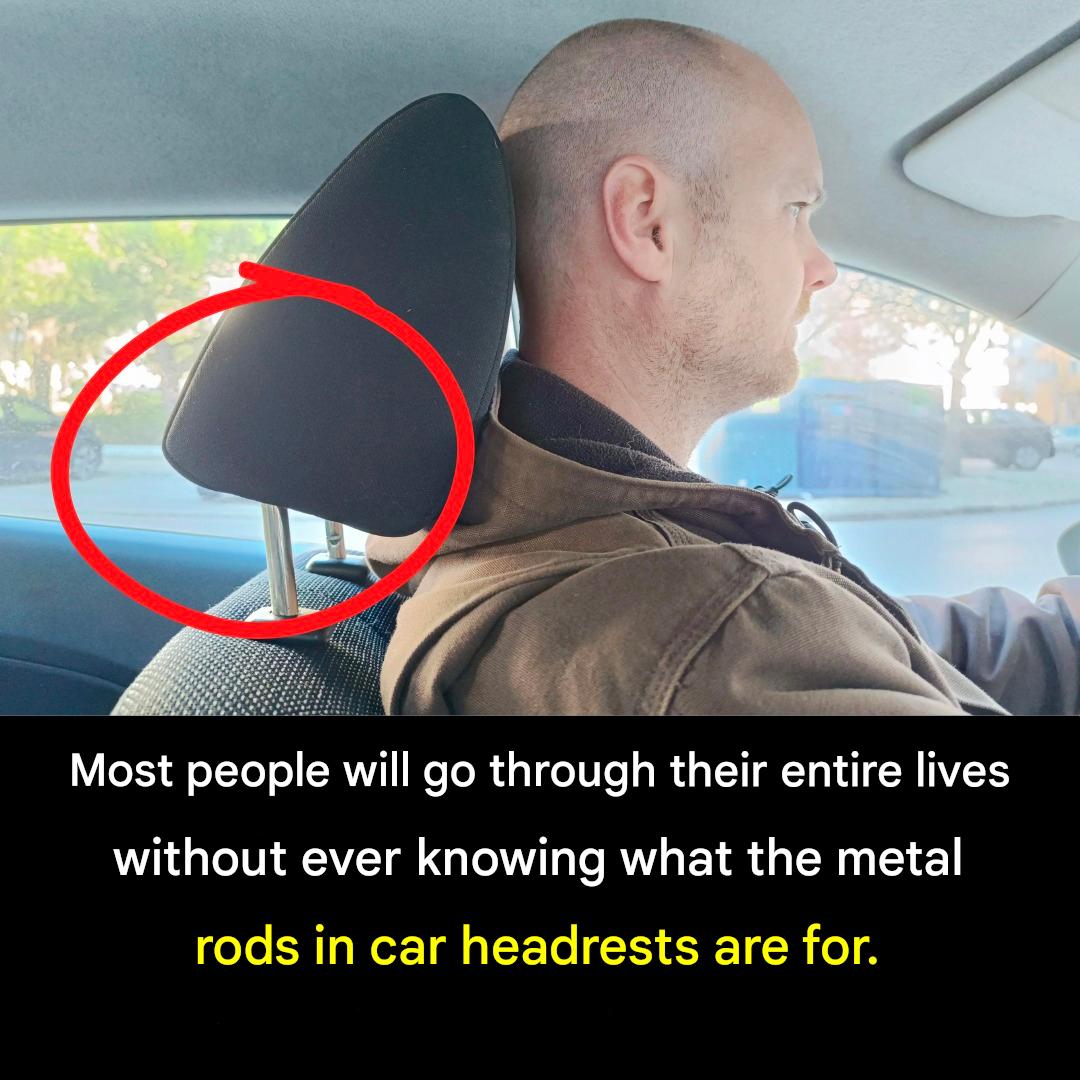
Why are car headrests equipped with metal rods? — A safety feature often overlooked by drivers
You get in the car, adjust your seat, buckle your seatbelt… and the headrest? It’s there, firmly in place, but we almost never think about it. Yet, the two thin metal rods that hold it aren’t just a simple support. They play a key role in your safety. And many drivers are unaware of this essential function.
These metal rods that watch over your neck
At first glance, these rods are used to adjust the height of the headrest. But their function goes far beyond that.
They securely attach the cushion to the seat frame. In the event of a rear-end collision, they prevent the headrest from tipping or sinking. As a result, the head is better supported and sudden movements are limited.
This support helps to reduce the risk of cervical trauma, often called “whiplash”.
According to the National Highway Traffic Safety Administration, a properly positioned headrest significantly reduces the risk of neck injuries in a moderate-speed rear-end collision.
A small adjustment can therefore have a big impact.
Preventing sudden movements: a crucial role
In a rear-end collision, the body is thrown forward while the head tends to snap backward before snapping back. Without a properly positioned and securely fastened headrest, this movement is amplified.
The metal rods are designed to withstand significant forces. They keep the headrest stable precisely when the body needs it most.
The Insurance Institute for Highway Safety emphasizes that the quality and proper adjustment of headrests directly influence the level of protection offered to passengers.
In other words: this discreet detail actively contributes to your safety.
A common mistake made by drivers
We adjust our seat… but we forget the headrest.
Here are the most common mistakes:
headrest positioned too low;
too great a distance between the head and the cushion;
rods not properly engaged after adjustment;
headrest removed and then incorrectly reinstalled.
A headrest that is too low loses much of its effectiveness. If the rods are not properly locked, stability can be compromised.
Fortunately, it only takes a few seconds to fix this.
How to properly adjust your headrest in 30 seconds
Sit up straight with your back against the backrest.
Adjust the height: the top of the headrest should reach the level of the top of your head.
Check the distance: the back of your head should ideally be between 2 and 4 cm from the cushion.
Make sure the rods are properly inserted and locked.
Remember to check this setting after moving your seat forward or backward: a change of position can alter the alignment.
Security designed down to the smallest detail
These metal rods illustrate the logic of modern automotive design: protect effectively, without attracting attention.