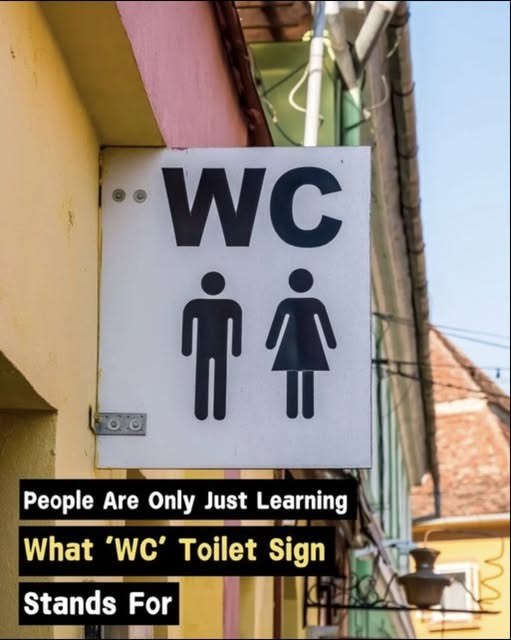
Meaning behind the ‘WC’ sign outside bathrooms
If you’ve ever traveled abroad and come across a door marked WC, you may have paused in confusion. You’re not alone—people around the world still find themselves puzzled by this two-letter abbreviation. At its simplest, WC stands for “water closet”, a term that identifies a small room containing a toilet and often a sink. Yet despite its straightforward meaning, the phrase feels outdated, quirky, and oddly formal compared to the words most of us use in daily life. And truthfully, it doesn’t make much more sense than calling the same space a restroom, bathroom, lavatory, or loo.
The Origin of WC
The term “water closet” dates back to the 19th century, during a time when indoor plumbing was becoming more common in Europe. Early toilets required a supply of water to flush waste away, and these rooms were often tucked into small, closet-like spaces. Abbreviating “water closet” into WC made sense in architectural plans and signage.
Over time, though, the phrase fell out of favor in many English-speaking countries. In Britain, “loo” became the everyday term, while in the United States, “bathroom” or “restroom” took over. Despite that, WC has lingered on—especially in parts of Europe and Asia, where signs for public toilets often still use the abbreviation.
Bathroom, Restroom, Washroom… and Beyond
The confusion around WC is just one piece of a larger puzzle: the wide variety of words people use to describe the same essential space. In the U.S., “bathroom” is most common—even when the room doesn’t contain a bath. Public facilities are often called “restrooms,” a term that suggests relaxation more than necessity. In Britain, “toilet” or “loo” are widely used, while Australians may say “dunny.” In Canada, the word “washroom” is typical, which often confuses visitors from south of the border.
In 2020, a couple named Shelby and Dylan highlighted this difference in a viral TikTok video. As Dylan walked past a sign marked “washroom,” he exclaimed, “What in the world is a washroom?” The lighthearted clip sparked thousands of comments, with Canadians defending the term and Americans admitting they had never heard it used that way. The debate quickly revealed just how inconsistent—and amusing—bathroom terminology can be.
Why So Many Names?
Linguists point out that bathroom language often reflects cultural values and social taboos. Because discussing bodily functions can feel impolite, societies invent softer, more indirect terms. That’s why Americans say “restroom” in public places, the British politely excuse themselves to the “loo,” and many Europeans rely on the technical-sounding WC. Each phrase allows people to sidestep awkwardness while still communicating where they’re headed.
Global Travel Tip
For travelers, knowing these variations can save you from embarrassing situations. In Germany, signs often use WC. In France, you’ll see “toilettes.” In Japan, the English word “toilet” is commonly used on public signage. In Canada, “washroom” is standard, while in the U.S., “restroom” is the safest bet in public settings.
Conclusion
So, what exactly is a WC? Technically, it’s just a water closet—a room with a toilet. But the larger story is that around the world, people have developed dozens of ways to describe the same place. Whether you ask for the restroom, the bathroom, the washroom, or the loo, chances are everyone knows what you mean. The mystery of the WC may not be fully solved, but one thing is certain: no matter what we call it, we all need it.