Meet the Antarctic Worm Whose Teeth Are Straight Out of Your Worst Nightmares
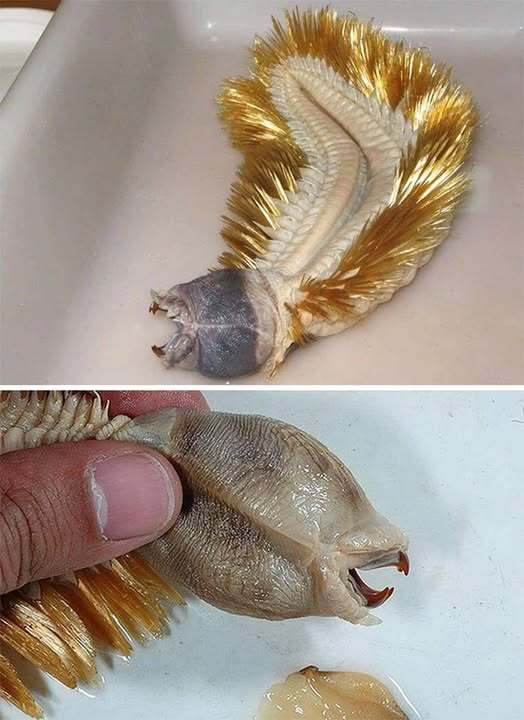
A remarkable Antarctic marine worm, Eulagisca gigantea, has recently gained massive attention online for its striking and otherworldly appearance. With its metallic golden bristles, segmented body, and a mouth lined with sharp, tooth-like structures, the worm looks more like a creature from a science fiction movie than a real organism living in Earth’s oceans. Photos of the bizarre-looking creature have gone viral across social media, sparking both fascination and fear among viewers who are amazed that something so alien exists in nature.
Despite its recent fame, Eulagisca gigantea is far from a new discovery. The species was first described in 1939 by scientists studying Antarctic marine life. It inhabits the frigid, dark waters of the Southern Ocean surrounding Antarctica, an area that remains one of the least explored regions on the planet. The remoteness and extreme conditions of this environment have kept the worm hidden from public awareness for decades. Only with the rise of deep-sea exploration technology and high-resolution photography has this remarkable species finally captured the world’s attention.
The worm itself can grow to about eight inches, or roughly twenty centimeters, in length. Its most distinctive feature is its large, retractable pharynx, or throat, which can be extended outward like a tube. Inside are sharp, tooth-like structures that allow it to grasp and devour prey. This specialized feeding mechanism reveals that Eulagisca gigantea is an active predator, not merely a scavenger. It preys on smaller organisms that inhabit the cold seafloor, demonstrating an impressive adaptation to a habitat where food can be scarce and conditions are harsh.
Its shimmering golden bristles, known as setae, are not just for show. Scientists believe these bristles serve multiple practical functions. They may help the worm crawl across the seabed, provide sensory feedback about its surroundings, or even act as a defense mechanism by deterring potential predators. The metallic sheen could also play a role in camouflage, reflecting light in a way that helps it blend into the dim, glittering environment of the deep Antarctic waters. Each of these traits highlights the worm’s remarkable ability to survive in one of the most inhospitable ecosystems on Earth.
Eulagisca gigantea belongs to the polychaete group, a diverse class of segmented worms found in oceans worldwide. Polychaetes play crucial roles in marine ecosystems. They burrow through sediment, helping to recycle nutrients and oxygenate the seafloor, and they serve as an essential food source for fish, crustaceans, and other marine animals. Although this particular species lives in extreme conditions, it shares many ecological functions with its relatives in warmer seas, proving how adaptable and vital polychaetes are to the balance of ocean life.
The viral attention surrounding Eulagisca gigantea serves as a reminder of how much of Earth’s ocean remains unexplored. Over eighty percent of the seafloor has yet to be mapped or studied in detail, meaning that countless extraordinary species may still be hidden in the depths. The fascination sparked by this golden Antarctic worm reflects a growing curiosity about the planet’s last great frontier. As technology continues to advance, from remotely operated submersibles to high-definition underwater imaging, scientists expect to uncover more creatures that defy expectations and expand our understanding of evolution and survival.
Ultimately, Eulagisca gigantea is not just a viral curiosity. It is a symbol of the deep sea’s mystery and resilience. Its existence reminds us that life can thrive even in the coldest, darkest corners of the Earth, adapting in ways that challenge imagination. Each new glimpse into these hidden worlds deepens our appreciation for the vast diversity of life that shares our planet.