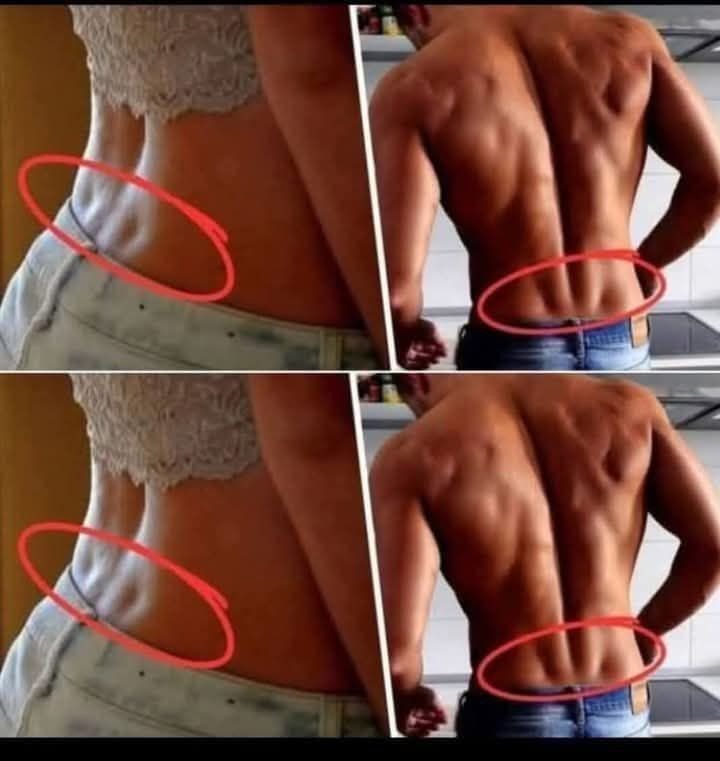
If you have these two holes in your back, it means…
Venus dimples are not like abs or glutes. You cannot build them through exercise. They are anatomical features, not muscular ones. Their appearance is determined by the way certain ligaments connect the skin to the pelvis and by the natural shape of the underlying bone structure.
That said, if you already have the correct ligament placement and pelvic anatomy, their visibility can change over time. Reducing overall body fat, especially in the lower back region, can make them more noticeable. Strengthening the surrounding muscles, particularly the core and glutes, can also enhance their appearance by improving tone and definition around the area. These changes do not create the dimples themselves, but they can make existing ones stand out more clearly.
However, if your anatomy does not include those connective structures, no number of squats, planks, or deadlifts will generate them. And that is completely normal. Human bodies vary widely by design, and Venus dimples are simply one of many naturally occurring differences.
❤️ Are They a Sign of Good Health?
Venus dimples are not a medical indicator and they are not a guarantee of fitness or wellness. Still, they are often associated with certain physical traits that tend to accompany good health. These may include a lower percentage of body fat, especially visceral fat, strong core and pelvic stability, balanced posture and spinal alignment, and healthy circulation through the lower back and pelvic region.
In fitness, dance, and athletic communities, Venus dimples are sometimes viewed as a natural marker of conditioning. This is not because the dimples themselves cause health, but because they are more visible on bodies that are lean, strong, and well supported by the core. Even so, many people who are extremely fit and healthy never develop visible dimples at all.
⚠️ Important Perspective
The absence of Venus dimples does not indicate poor health. Millions of strong, capable, vibrant people do not have them. Their presence or absence is not a scorecard of physical achievement. It is simply a variation in anatomy.
🏺 A Touch of History and Culture
Across history, Venus dimples have often been celebrated as symbols of beauty and harmony. Ancient Roman and Greek sculptures frequently included them in representations of gods, goddesses, and idealized human figures. Artists during the Renaissance continued this tradition, subtly highlighting them in paintings of muses and mythological figures as a sign of elegance, fertility, and divine proportion.
In modern times, they are admired in ballet, yoga, and fitness photography for the sense of symmetry and softness they add to the lower back. Their quiet presence in art across centuries reminds us that the human body has long been seen as something to admire and study in all its natural forms.
💛 Final Thought: Beauty in Diversity
Venus dimples are lovely. But they are only one of countless features that make each body unique.
Some people have them.
Some people do not.
Some have one.
Some have two that are asymmetrical.
None of these variations affect your worth, your strength, or your beauty.
What matters far more is how you feel in your own skin, how you move your body with care, and how you treat yourself with patience, kindness, and respect.
So whether your lower back is dimpled or smooth, remember this.
You are already whole.
You are already enough.
And if you do have them, you can think of them as a small inherited signature, a quiet detail passed down through generations, reminding you that your body carries both history and individuality in every curve and contour.