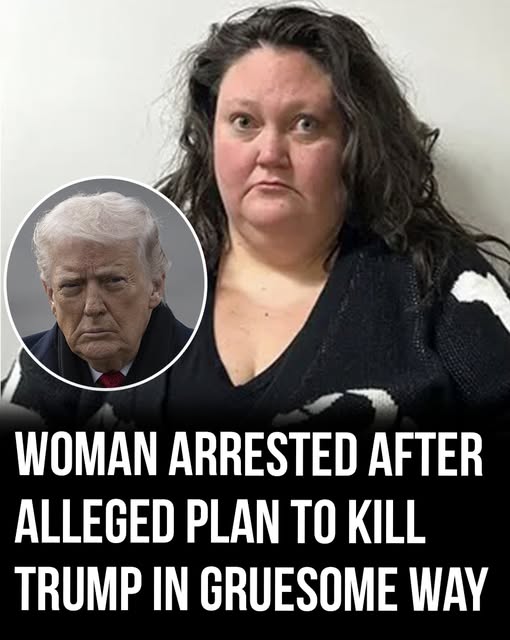
Woman taken into custody after authorities foil alleged Trump plot
A librarian from Ripley, West Virginia, has been arrested and charged after local law enforcement said she used social media.
in a way that allegedly crossed from controversial political commentary into a criminal terroristic threat. The case has drawn attention nationally due to the nature of the alleged conduct and the political figure referenced.
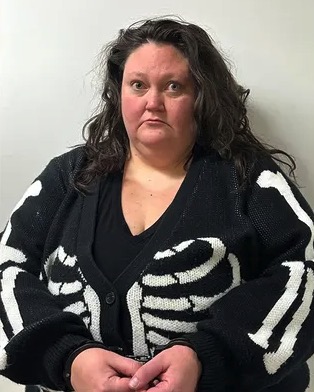
The woman at the center of the case is Morgan L. Morrow, age 39, a resident of Ripley, West Virginia and an employee at the Jackson County Public Library.
According to the Jackson County Sheriff’s Department, she was arrested on Sunday evening, January 25, 2026, and charged with one count of making a terroristic threat.
Local law enforcement identified Morrow as a librarian at the Jackson County Public Library when announcing the arrest and said that the alleged actions involved the recruitment of individuals via social media for violence against a public figure.
The Social Media Post That Sparked the Investigation
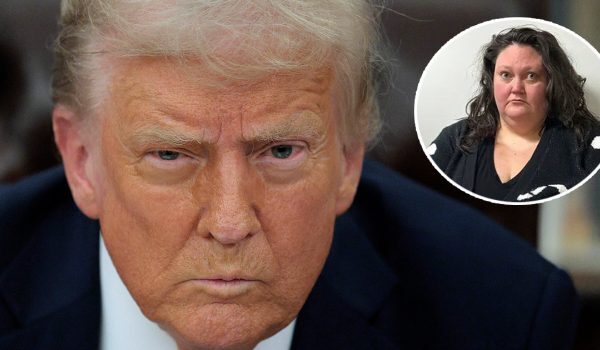
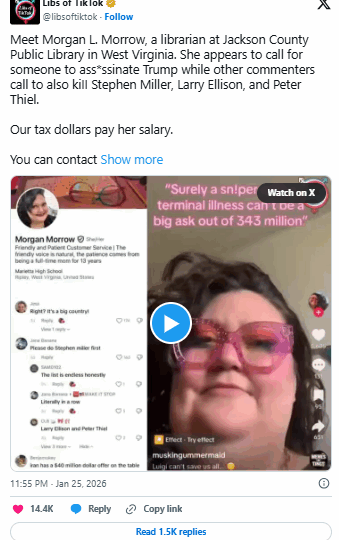
Investigators said the case began after deputies became aware of a video circulated on the social media app Instagram and TikTok that they found deeply concerning.
The video, which was publicly accessible, included a caption that read: “Surely a sniper with a terminal illness cannot be a big ask out of 343 million.”
Sheriff Ross H. Mellinger, who spoke publicly about the arrest, said authorities interpreted the statement — particularly in context — as a potential attempt to recruit others to consider violent action against then‑President Donald J. Trump.
The Jackson County Sheriff’s Department wrote on social media that the case involved a “social media recruitment of individuals to pursue and assassinate President Trump.”
While the sheriff stressed the investigation is not politically motivated, he described the remarks as “documented and troubling.”
What Charges Morrow Faces
Morrow was charged with a single count of terroristic threats. Under West Virginia law, a terroristic threat charge can apply when someone communicates, directly or indirectly, statements that suggest violence or encourage others to commit violent acts.
This includes statements that could “encourage, inspire, or entice” wrongdoing, even if the speaker does not personally plan to commit it.
After being taken into custody, Morrow was transported to the South Central Regional Jail in West Virginia, where she remained while the investigation continued.
Details From the Criminal Complaint
According to reporting from The Marietta Times, the criminal complaint alleged that deputies were alerted to potential threats of violence when reviewing Morrow’s TikTok and Instagram posts.
In addition to the original caption about a “sniper with a terminal illness,” authorities noted that the wording, context, and timing led them to interpret the post as encouraging others to act on violent intent.
The complaint reportedly says that while being interviewed by investigators, Morrow admitted she wrote the statement and acknowledged that it was directed at the then‑President.
She allegedly said that she did not personally intend to carry out violence herself, but expressed “personal reasons for wishing harm upon the President.”
Officials emphasized that an expressed lack of personal intent does not necessarily prevent a charge of terroristic threats — especially if a communication could reasonably influence others to commit a crime under the law.
Reactions and Commentary Online
Once the story began circulating on social media platforms and news sites, the video and its caption drew widespread attention and reaction.
Some commenters on the original post allegedly expanded the rhetoric, mentioning other high‑profile individuals such as White House Deputy Chief of Staff for Policy Stephen Miller, tech CEO Larry Ellison, and entrepreneur Peter Thiel, though these comments did not appear to be directly tied to the original suspect.
Local reporting confirms that law enforcement was focused specifically on the underlying post and its potential to incite others rather than any wider conspiracy or network.
Law Enforcement’s Position
Sheriff Ross Mellinger addressed the arrest directly in media interviews, saying: “When you saddle up on the horse of stupidity, you have to be prepared for the ride that follows.”
He added that law enforcement’s priority was preventing potential violence and ensuring that no one else would be inspired to follow a similar course of action.
Mellinger also noted that while citizens are free to express their political opinions — even strongly — there is a clear legal boundary when communications *cross into threatening language that could reasonably prompt others to commit violent acts. This investigation, he said, is about public safety rather than partisan viewpoints.
Response From the Jackson County Public Library
Following Morrow’s arrest, her employer issued a public statement emphasizing that the remarks she made — as alleged by law enforcement — do not reflect the values or mission of the library.
The statement said the library “takes our responsibilities to the public and our supporters seriously” and is addressing the matter internally in accordance with established policies.
The library’s post stressed that the views expressed were made by an individual and not on behalf of the organization. The library did not provide further details about employment status or administrative action beyond reaffirming its mission and values.
Legal Context: Threats, Free Speech, and Enforcement
Under U.S. law, there is a well‑established balance between protecting free speech under the First Amendment and preventing communications that constitute direct threats or incitement to violence.
Threats against government officials — especially the President — are treated especially seriously due to potential risk and security considerations.
Legal experts note that communications framed as threats or solicitations for violence — where an ordinary person could reasonably interpret them as a call to action — can be prosecuted even if the speaker claims no intent to personally act. In practice, courts consider the speaker’s words, context, and the foreseeable impact on listeners or followers.
Authorities have emphasized that the criminal complaint in this case was based on the combination of statement wording and the interpretation that it could encourage or inspire others to commit violence against a public official — a prosecutable act under West Virginia’s terroristic threat statutes.
Political Context and Broader Concerns
The arrest comes amid heightened political tensions in the United States, where threats and violent rhetoric have occasionally spilled into criminal investigations.
Secret Service regulations make threats against current and former presidents a federal concern, and many jurisdictions treat such threats as serious public safety issues rather than protected speech.
While other threats or plots (whether actual or alleged) against public figures often become widely reported, officials continue to stress that each incident is evaluated on its own merits, with law enforcement focused on actual risk rather than ideological disagreement.
Status of the Investigation
At this point in the case, Morrow has been charged and is in custody. The investigation is ongoing, and prosecutors will determine how to proceed with prosecution based on the evidence gathered, including the statements made in the social media posts and her admissions during the interview.
If convicted, terroristic threat charges can carry significant legal consequences, including potential jail time and fines, particularly when the alleged threat involves a public official such as a president.
What This Case Illustrates About Online Speech and Threats
The Morgan Morrow case highlights a broader legal and societal tension: when does controversial or offensive speech cross the line into criminal conduct?
While political disagreement and criticism are fundamental to democratic debate, law enforcement agencies state that they are obligated to act when communications reach a level that could reasonably be seen as encouraging violence or endangering public safety.
This incident also illustrates the extent to which social media platforms can spread statements rapidly, prompting swift reaction from the public and authorities alike. Similar situations in recent years have led courts and prosecutors to pay close attention to context, audience, and potential risk when evaluating online posts.
Conclusion
A West Virginia librarian has been arrested and charged with making a terroristic threat after law enforcement alleged she used social media to encourage others to commit violence against a former U.S. president.
The case emphasizes how threatening language aimed at inciting wrongful acts — even if framed indirectly — can result in criminal charges, particularly when they involve public officials.
Authorities continue to investigate, and this case will likely proceed through the local legal system in the weeks and months ahead, with both legal and constitutional questions part of the continuing discussion about free speech and public safety.