The Homeless Girl Returned What I Thought Was Gone Forever
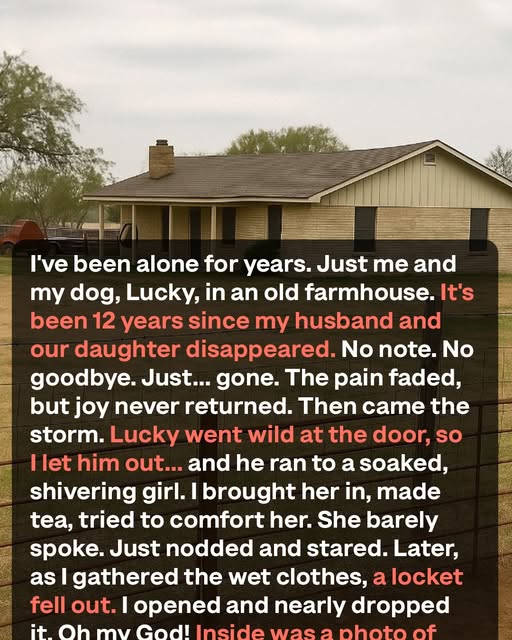
A fierce storm hammered my isolated farmhouse, the wind howling like a creature in pain as sheets of rain lashed the windows and rattled the roof. The trees outside bent at impossible angles, their skeletal branches clawing at the sky. The power had flickered earlier and gone out completely, plunging the house into dim, flickering candlelight. I sat in the living room, wrapped in an old quilt, sipping lukewarm tea, listening to the chaos outside, trying not to let the memories creep in.
Only Lucky, my aging retriever with more gray in his fur than gold, kept me company. He had always been a calm dog—steadfast, loyal, slow-moving in his old age. But that night, something was different. As the storm intensified, Lucky grew increasingly restless. He stood stiffly at the front door, tail taut, ears perked high, head tilted like he could hear something I couldn’t. He paced, back and forth, letting out low, anxious whines, then barked once—sharp, urgent. No amount of coaxing soothed him.
I tried to tell myself it was just the storm. Maybe a branch had fallen, or some stray animal was taking shelter nearby. But Lucky wouldn’t leave the door. Finally, curiosity—and a growing sense of unease—pushed me to act. I pulled on my coat, grabbed a flashlight, and cracked open the door.
Before I could stop him, Lucky bolted into the darkness, his old body moving with surprising speed. I had no choice but to follow.
Rain hit me like a wall, and the wind almost stole the breath from my lungs. I shielded my eyes and hurried after Lucky, calling his name, my voice lost in the roar of the storm. That’s when I saw her—barely illuminated in the flashlight beam, huddled at the bus stop just beyond the gravel road. She was small and soaked to the bone, her hair plastered to her face, arms wrapped tightly around her knees. Her body trembled violently, but it was her eyes that stopped me cold: wide, empty, and haunted by something deeper than just the storm.
She looked like she hadn’t spoken to anyone in days.
I didn’t hesitate. I rushed to her side, draped my coat around her shivering frame, and led her back to the house. Lucky walked close beside us, a silent guardian. Once inside, I wrapped her in dry blankets, gave her warm clothes from a storage chest, and brewed a cup of cocoa over a gas burner. She said little—only nodded in thanks—but her silence was heavy, charged with something unspoken. Her eyes never wandered far from the door, as if she were still deciding whether to run.
I didn’t push. I just stayed close, letting the warmth and quiet work their way through.
It was when I reached for her backpack—soggy and sagging—that something tumbled out. A small, rusted, heart-shaped locket.
The sight of it made my breath hitch. My hands trembled as I picked it up, my fingers automatically finding the tiny clasp. When I opened it, my heart nearly stopped.
Inside were two small, faded photos—one of me, and one of Tom, my husband. Photos that had been carefully placed there years ago, in a locket that should not have existed anymore. Because I had buried it—buried it deep along with my grief after the night my daughter, Emily, vanished during a devastating storm twelve years ago. She had been only five, swept away near the river when the floodwaters rose faster than we could react. No body was ever found. Just the locket, discovered days later near a shattered branch. That was all I had left of her.
But now, here it was again, in my palm. In perfect, painful clarity.
I looked up at the girl. She had been watching me closely, her eyes no longer hollow but searching—almost familiar.
“Where did you get this?” I asked, my voice barely a whisper.
She hesitated, then answered softly. “My dad told me to find you.”
I blinked. “Your dad?”
She nodded. “He said you’d keep me safe.”
A name caught in my throat. “What’s your name?”
She looked down, then up at me again, and said quietly, “Anna.”
But something flickered in her gaze, and I saw it—the impossible. Beneath the layers of time and trauma, the dirt and pain, I saw the truth. I saw Emily.
I didn’t need proof. I didn’t need more answers. The way she looked at me—uncertain but yearning—the way Lucky sat pressed against her side, unmoving. I knew.
In the heavy stillness of the storm’s wake, emotions crashed louder than any thunder. Grief, disbelief, hope, and overwhelming love surged all at once. I moved closer, not even aware that tears were pouring down my face. She didn’t pull away when I wrapped my arms around her. Instead, she leaned in and let herself be held.
After twelve long years, fate—or maybe something far greater—had led her home through another storm.
We said very little after that. We didn’t need to. The silence between us had changed. It wasn’t filled with fear anymore—it was full of recognition, of reunion, of healing. That night, as the rain eased and the wind quieted, a different kind of peace settled over the house.
Emily was home.
And this time, I wasn’t letting her go.